
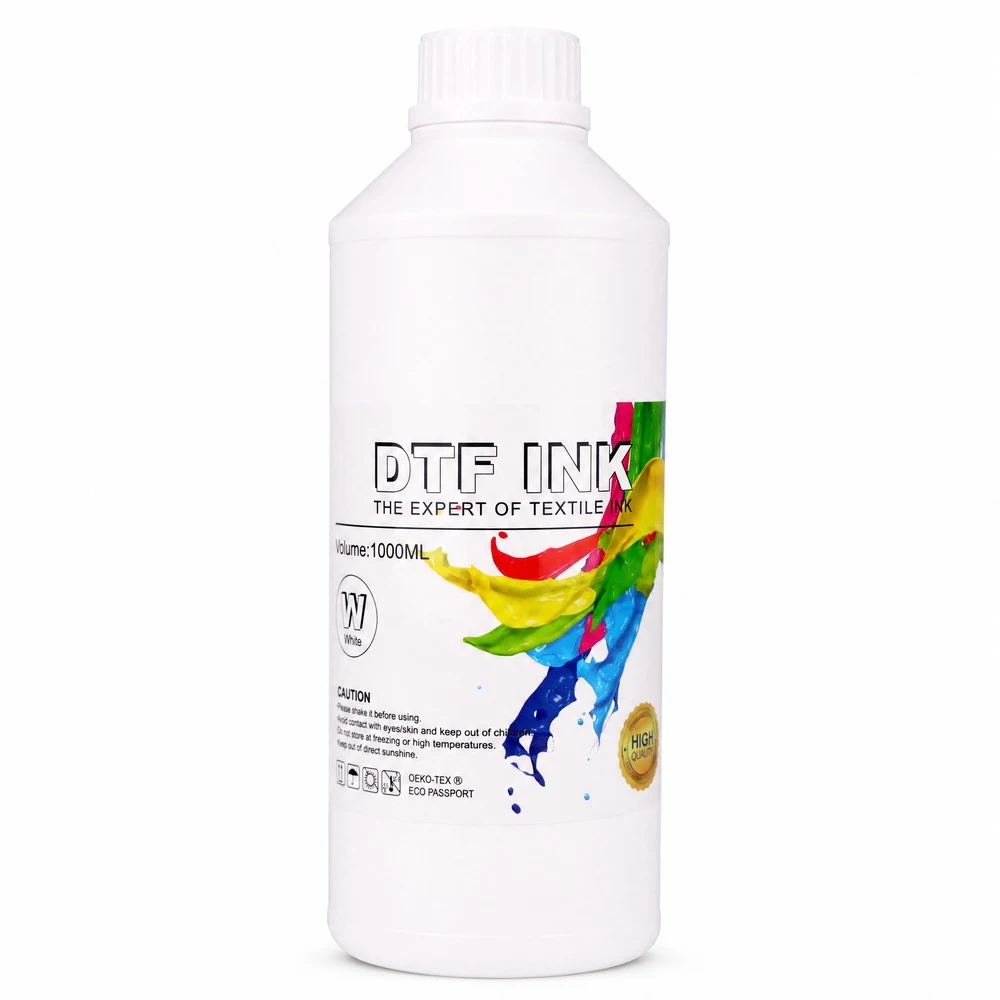
DTF Ink for Epson i3200 vs. XP600: Engineering Guide to Viscosity, Jetting Stability & Printhead Care

Technical Whitepaper • Digital Textile Fluid Rheology
Executive Summary: Modern Direct-to-Film (DTF) apparel printing relies predominantly on two piezo printhead architectures: industrial Epson PrecisionCore i3200-A1 heads and converted commercial Epson XP600 (F1080-A1) heads. While ink vendors often market “universal” DTF inks, fluid mechanics dictate that an ink optimized for the high firing frequency (21.6 kHz) and small droplet volume (3.8 pL) of an i3200 will behave radically differently in an XP600 running lower drive voltages and slower acoustic cycles. This technical guide outlines the critical rheological tolerances (dynamic viscosity, surface tension, and sub-micron pigment dispersion), white titanium dioxide (TiO2) sedimentation kinetics, and maintenance procedures required to eliminate nozzle starvation, satellite misting, and premature head failure.
Quick Technical Answer: Can you run the same DTF ink in both Epson i3200 and XP600?
Yes, but only if the formulation maintains a narrow viscosity window of 4.5–5.5 mPa·s (cP) at 25°C, surface tension between 30–32 mN/m, and sub-180 nm particle sizing. The Epson i3200 fires at up to 21.6 kHz and demands rapid meniscus recovery to prevent ink starvation at high linear speeds, whereas the XP600 operates at 10.5–14.4 kHz with smaller drive actuators that are vulnerable to deflection when ink viscosity exceeds 6.0 mPa·s. Mismatched inks cause ink starvation on i3200 production lines and severe nozzle dropouts or electrical burnout on XP600 carriages.
1. PrecisionCore i3200 vs. MicroPiezo XP600: Architecture & Mechanical Differences
Direct-to-Film transfer printing requires precise drop-on-demand ink jetting onto PET release film. The mechanical heart of any DTF machine is its printhead. Understanding the architectural divide between the Epson i3200 and XP600 explains why ink performance differs so drastically across the two platforms.
The Epson PrecisionCore i3200-A1 is an industrial printhead engineered specifically for water-based textile and digital production equipment. It utilizes micro-electro-mechanical system (MEMS) thin-film piezo actuators manufactured with sub-micron semiconductor precision. With 3,200 nozzles distributed across 8 lines (400 nozzles per line at 600 nozzles per inch), it delivers immense nozzle density, superior drop velocity, and high mechanical resilience.
In contrast, the Epson XP600 (also designated F1080-A1 in commercial DTF builds) originates from desktop consumer photo printers (Epson Expression Photo XP-600 series). It features traditional bulk piezoelectric ceramics with 1,080 nozzles across 6 lines (180 nozzles per line). Machine builders adapted the XP600 for entry-level and mid-tier commercial DTF printers due to its low unit replacement cost. However, its acoustic chamber volume, nozzle diameter, and actuator driving power are significantly lower than those of the i3200.
Key Engineering Insight: Because the XP600 possesses smaller piezoelectric elements, it provides less acoustic drive displacement. If an ink has excessive viscosity or poor rheological elasticity, the XP600 nozzle cannot deform the fluid meniscus cleanly, leading to misdirected drops (deflection) or burnt drive channels. Conversely, the high-speed i3200 fires drops twice as fast; an ink with slow surface tension recovery will starve the nozzle during continuous high-pass production runs.
2. Side-by-Side Technical Specification Matrix
The table below summarizes the core mechanical and fluidic parameters comparing the industrial Epson i3200-A1 against the commercial XP600/F1080 printhead for DTF ink jetting:
| Specification Parameter | Epson PrecisionCore i3200-A1 | Epson XP600 / F1080-A1 |
|---|---|---|
| Target Equipment Grade | Industrial Production (60cm / 120cm, 2-4 Heads) | Entry / Commercial Desktop (30cm / 60cm, 1-2 Heads) |
| Total Active Nozzles | 3,200 (8 lines × 400 nozzles) | 1,080 (6 lines × 180 nozzles) |
| Nozzle Density (Resolution) | 600 npi per line (1.33 inch print width) | 180 npi / 360 npi staggered (~0.98 inch print width) |
| Maximum Firing Frequency | 21.6 kHz (Up to 43.2 kHz in multi-pulse mode) | 10.5 kHz – 14.4 kHz |
| Droplet Volume Range (VSDT) | 3.8 pL to 12.5 pL (Multi-drop waveform control) | 3.5 pL to 20.0 pL |
| Optimal Dynamic Viscosity (25°C) | 4.5 – 5.2 mPa·s (cP) | 4.2 – 5.5 mPa·s (cP) |
| Surface Tension Window | 30.0 – 32.0 mN/m (Rapid meniscus damping) | 28.0 – 32.0 mN/m |
| Maximum Print Speed (Typical) | 15 – 25 m²/h per head (4-pass / 6-pass) | 4 – 8 m²/h per head (6-pass / 8-pass) |
| Ink Supply & Pressure Control | Active negative pressure or sealed sub-tank damper | Direct damper gravity / siphon suction |
| Head Replacement Cost (Unit) | ~$900 – $1,300 USD | ~$200 – $350 USD |
| Standard Operating Lifespan | 12 – 24 months (With compliant nano DTF ink) | 4 – 8 months (Higher mechanical degradation) |
3. Ink Rheology: Viscosity, Surface Tension & Firing Waves
Inkjet printing is not merely pumping liquid through tiny holes; it is acoustic fluid mechanics governed by the Navier-Stokes equations and piezo voltage excitation waveforms. In DTF printing, the ink must transition from rest in the nozzle chamber to a high-speed droplet travelling at 6 to 10 m/s, separate cleanly without forming satellite tails, and allow the fluid meniscus to settle within microseconds before the next cycle.
A. The Meniscus Recovery Challenge at 21.6 kHz
At 21.6 kHz, an Epson i3200 nozzle fires a droplet every 46.3 microseconds. During this window, the piezo crystal contracts to draw ink into the chamber, expands to eject the droplet, and pulls back slightly to brake the meniscus. If the DTF ink has an excessively high dynamic viscosity (> 5.8 mPa·s), ink refill is too slow. The nozzle cavity starves, resulting in blank lines during solid color fills or white underbases. Conversely, if viscosity is too low (< 3.8 mPa·s), the ink fails to dampen acoustic reflections, causing ink weeping across the nozzle plate, electrical short-circuits, and fine ink mist settling onto the linear encoder strip.
B. Actuator Strain in XP600 Printheads
While the XP600 runs at a more forgiving frequency (~12 kHz), its piezo elements are physically larger and generate less force per unit area. When print shops run cheap or dense DTF inks through an XP600, the head requires elevated drive voltage from the mainboard to jet droplets. Over weeks of production, this excessive drive voltage causes piezo thermal stress, channel cross-talk, and eventual internal diaphragm rupture (manifested as ink bleeding between adjacent color channels).
C. Temperature-Viscosity Relationship in Print Shops
Digital textile inks exhibit non-Newtonian shear-thinning characteristics strongly influenced by ambient temperature:
- At 18°C (Cold workshop): DTF ink viscosity rises by 25% to 35%, frequently exceeding 7.0 mPa·s. Both i3200 and XP600 heads will suffer severe nozzle dropouts, misdirected spray, and partial clogging.
- At 22°C – 25°C (Target operating window): Enlite DTF inks maintain their optimal 4.8 – 5.2 mPa·s fluidic curve, providing crisp droplet formation and clean cutoff.
- Above 32°C (Overheated workshop): Ink viscosity drops below 4.0 mPa·s, and solvent evaporation accelerates at the nozzle faceplate, creating dry crust rings around nozzles.
Workshop Practice Tip: Always store bulk DTF ink in the same climate-controlled room as your printing equipment for at least 24 hours prior to filling. Running ink that is 10°C colder than the printer carriage will cause erratic nozzle checks during morning startups.
4. White Ink Chemistry: TiO2 Sedimentation & Clog Prevention
White ink is the foundation of DTF garment printing. Because DTF prints must achieve vivid opacity on black cotton, canvas, and polyester, the white underbase relies on Titanium Dioxide (TiO2) as its primary white pigment. However, TiO2 presents an inherent physical challenge: its specific gravity is approximately 4.2 g/cm³, while the water and glycol liquid carrier has a density of roughly 1.05 g/cm³.
According to Stokes’ Law, the sedimentation velocity (v) of a spherical particle suspended in a fluid is directly proportional to the square of its radius (r^2) and the density difference between the pigment particle and the fluid carrier:
v = [ 2 × r² × (ρparticle – ρfluid) × g ] / ( 9 × η )
Because TiO2 is four times denser than water, gravity constantly pulls pigment particles to the bottom of ink tanks, tubing lines, and printhead dampers. If an ink manufacturer uses low-grade dispersing agents, the settling particles form hard cake flocculation—a dense, cement-like sludge that cannot be redispersed by shaking and permanently seals the microscopic filters inside printheads.
Generic / Low-Cost White DTF Ink
- Electrostatic stabilization only; breaks down when exposed to trace ions or temperature swings.
- Particle agglomeration reaches > 350 nm within 48 hours of static standby.
- Requires aggressive head purges every morning, consuming 40–80 mL of wasted ink.
- Hard sedimentation settles in line elbows, requiring monthly damper and tubing replacements.
Enlite Steric Nano-Suspension Technology
- Steric polymeric shielding wraps each nano-TiO2 particle, creating physical steric repulsion.
- Ultra-fine particle size distribution (D90 < 180 nm), passing effortlessly through sub-micron head mesh.
- Loose flocculate structure redisperses effortlessly with gentle bottle agitation.
- Overnight standby capability: 15+ hours idle without head capping drying or nozzle crusting.
5. Matching Enlite Formulations to Your Production Line
Rather than forcing print shops into a one-size-fits-all compromise, Zhuhai Enlite Technology engineers dedicated DTF ink formulations calibrated for specific hardware setups, production cycles, and opacity requirements:
Full Color CMYK + White Set
Enlite M138 Bulk DTF Ink Set (CMYK + W)
The complete commercial workhorse for Epson i3200-A1 and XP600 printers. Features vivid high-chroma cyan, magenta, yellow, black, and white inks engineered for high wash fastness (Grade 4.5+), soft fabric stretchability, and anti-clogging stability across 1000 mL and 500 mL bulk packaging.
Desktop & Standby Specialist
Enlite M318 Premium Low-Sediment DTF White Ink
Formulated specifically for print shops running converted XP600 / L1800 printers with intermittent production schedules or limited white ink circulation. Its advanced anti-settling nano-suspension prevents hard compaction during idle periods, allowing immediate printing after overnight shutdowns without deep cleaning cycles.
Industrial Daily Production Line
Enlite M316 Standard Low-Sediment DTF White Ink
Engineered for commercial garment printing workshops operating continuous Epson i3200 2-head and 4-head production lines. Delivers balanced whiteness, 15-hour overnight standby with zero nozzle dropouts, smooth flow through active circulation sub-tanks, and exceptional bulk cost efficiency.
High-Opacity Underbase
Enlite M306 High-Coverage DTF White Ink
Formulated with dense titanium dioxide loading for heavy dark apparel, black fleece hoodies, canvas bags, and coarse textiles. Achieves maximum single-pass underbase opacity without requiring double-white printing passes, maximizing output speed on high-volume runs.
Browse our complete digital textile lineup in the Enlite DTF Ink Category, including CMYK bulk bottles, specialty fluorescent neon colors, and dedicated DTF cleaning solutions.
6. Safe Line Flushing & Ink Changeover Protocol
One of the most catastrophic mistakes in DTF print shops is pouring a new brand or formulation of ink directly into an existing ink tank. Different chemical manufacturers use proprietary surfactant systems, humectants, and polyurethane binders. When two chemically incompatible formulations mix inside printhead dampers or fluid channels, they frequently react to create gel precipitation, permanently choking the printhead.
When switching your Epson i3200 or XP600 printer to Enlite DTF ink, follow this 4-step dedicated line flushing protocol:
- Step 1: Complete System Evacuation: Drain the remaining old ink from bulk tanks, sub-tanks, and ink lines into a designated waste container. Do not leave ink sitting in tubing corners.
- Step 2: Flush with Dedicated DTF Cleaning Solution: Fill the ink tanks with approved water-based DTF cleaning solution (never use aggressive solvent or alcohol-based cleaners, which destroy internal piezo epoxy seals). Run 2 to 3 carriage pump cycles until the fluid flowing through the waste tubes runs completely clear.
- Step 3: Damper Inspection & Replacement: Inspect ink dampers and inline capsule filters. If dampers show yellowing, micro-mesh residue, or have been in operation for over 6 months, install fresh dampers before introducing new ink.
- Step 4: Priming & Nozzle Check: Pour Enlite DTF ink into the bulk tanks. Pull ink gently through dampers using a clean syringe and luer-lock fitting until the chamber is 70% full with no air bubbles. Reattach dampers to the printhead manifold, perform one normal clean cycle, and print a 100% nozzle verification test.
For comprehensive shift-by-shift printhead maintenance, refer to our detailed DTF Printer Maintenance Checklist & Troubleshooting Guide.
7. Commercial Sourcing & Quality Control Checklist for Print Shops
When sourcing DTF inks in bulk (drums, 20L carboys, or pallets of 1000 mL bottles) from direct China manufacturers, commercial buyers and distributors should enforce strict chemical verification standards:
Factory Audit Quality Benchmarks:
- Sub-Micron Filtration Certification: Confirm that the factory filters raw inks through a multi-stage 3-step absolute membrane filtration system ending at 0.2 μm to guarantee zero coarse particles.
- Spectrophotometer Color Consistency: Demand batch-to-batch color variance of ΔE < 1.0 under D65 standard illuminant, ensuring customer repeat orders match previous production runs exactly.
- TDS & SDS Documentation: Verify genuine factory Technical Data Sheets (TDS) and Safety Data Sheets (SDS) matching GHS standards for export logistics and workplace chemical safety.
- Bottle Foil Induction Sealing: Ensure bottles utilize hermetic aluminum induction foil seals and gas-permeable vented caps to prevent container collapse or leakage during transoceanic sea freight and air express shipping.
Request Commercial DTF Ink Samples from Zhuhai Enlite
Evaluate Enlite M138 color sets, M318, M316, or M306 white ink formulations on your Epson i3200 or XP600 equipment. Direct factory pricing, custom private labelling, and rapid international air dispatch.
8. Frequently Asked Questions (FAQ)
Q1: Can I use the exact same DTF ink bottle in both an Epson i3200 and an XP600?
Yes, provided the ink is formulated within the balanced 4.5–5.5 mPa·s viscosity and 30–32 mN/m surface tension range, such as Enlite M138 or M316. However, print shops must maintain appropriate heater platen temperatures and rip software color curves, as the drop volume curves between PrecisionCore (3.8 pL) and XP600 (3.5 pL) differ significantly.
Q2: Why does white DTF ink clog more frequently in XP600 printers than in i3200 printers?
Most XP600 printers lack the continuous positive/negative pressure circulation and sub-tank agitation systems found on industrial i3200 machines. In XP600 setups, white ink often sits static in dampers and tubing during overnight pauses, accelerating TiO2 gravity sedimentation. Using an anti-settling formulation like Enlite M318 Premium Low-Sediment significantly reduces this issue.
Q3: What causes ink starvation on the Epson i3200 printhead during high-speed printing?
Ink starvation occurs when the printhead fires drops faster than fluid can refill the nozzle acoustic cavity. Common culprits include: (1) Ink viscosity exceeding 5.8 mPa·s due to cold room temperatures (< 20°C); (2) Restrictive, clogged inline capsule filters; or (3) Defective sub-tank negative pressure calibration pulling excessive vacuum on the ink column.
Q4: How should a commercial print shop clean an i3200 head after a long weekend shutdown?
Do not immediately initiate consecutive powerful head cleanings, as repeated vacuum pumping can delaminate the nozzle plate membrane. Instead: (1) Apply a lint-free swab soaked in dedicated DTF cleaning fluid around the cap top rubber seal; (2) Perform a gentle capping station soak for 15 minutes to soften dried faceplate film; (3) Run a single normal clean cycle; (4) Print a nozzle test. If missing lines remain, inspect dampers and tubing integrity.
Q5: What certifications should I check when importing DTF consumables into Europe and North America?
Look for verified compliance with RoHS (restriction of hazardous heavy metals), REACH SVHC (Substances of Very High Concern), and OEKO-TEX® ECO PASSPORT for garment textile safety. Furthermore, reputable manufacturers must provide compliant Safety Data Sheets (SDS) matching GHS standards for international customs clearance.
★ Factory Direct Consumables Sourcing
Evaluating DTF Inks for Epson i3200 or XP600?
Request Zhuhai Enlite's 2026 Factory Wholesale Catalog, batch TDS/SDS documentation, and claim 1,000ml Free Evaluation Samples for your print shop or dealership.
✓ OEKO-TEX Eco Passport
✓ Low-Sediment Anti-Settling
✓ 24-48h Global Dispatch