
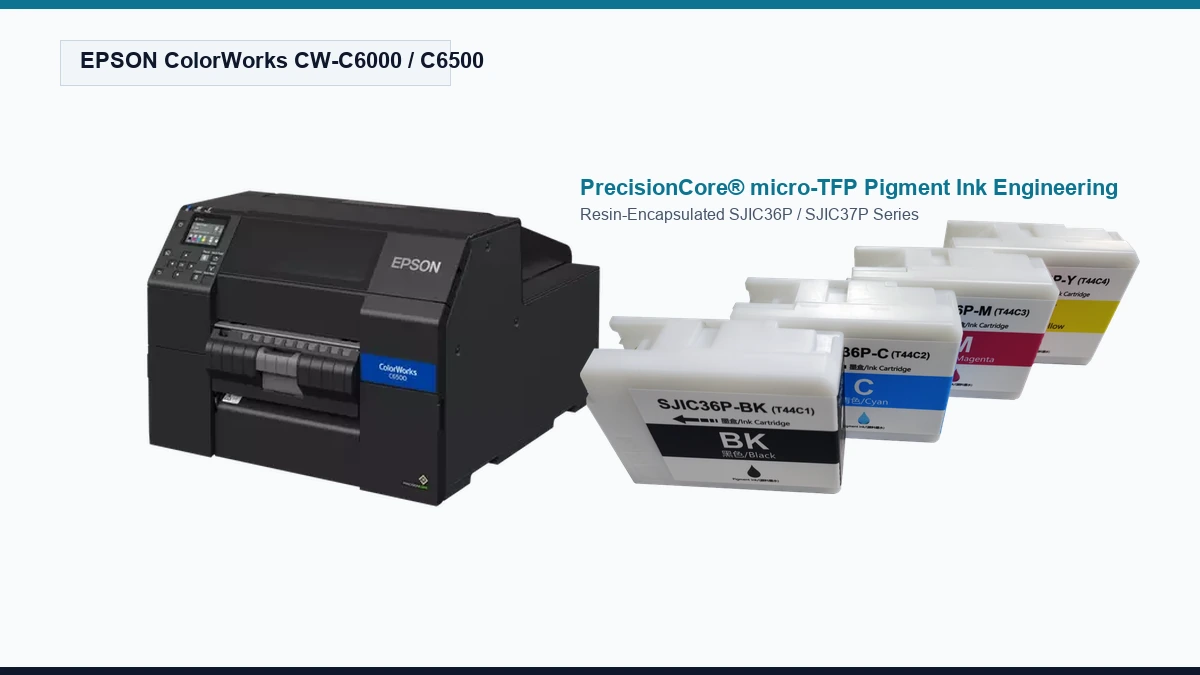
Industrial Color Label Printing Engineering Guide: Epson ColorWorks CW-C6000/C6500 Printhead Longevity, Pigment Fluid Mechanics, and Chemical Durability

Industrial Hardware & Consumable Focus: This engineering guide is tailored for high-volume converters and packaging plants operating the Epson ColorWorks® CW-C6000 (4-inch) and CW-C6500 (8-inch) series. For factory-direct, cleanroom-manufactured cartridges, explore our Epson ColorWorks CW-C6000 / CW-C6500 SJIC36P / T44C Compatible Pigment Ink Cartridge or browse all Commercial Label Printer Consumables.
1. Executive Summary: The Industrial On-Demand Label Paradigm Shift
Across modern manufacturing, chemical synthesis, pharmaceutical packaging, and logistics fulfillment, the legacy workflow of ordering tens of thousands of pre-printed flexographic labels has reached an economic and operational bottleneck. Shorter product lifecycles, stringent global serialization mandates, and multi-language Globally Harmonized System (GHS) chemical classifications demand just-in-time, full-color on-demand printing.
The Epson ColorWorks® CW-C6000 (4-inch web width) and CW-C6500 (8-inch web width) series have emerged as the industry benchmark for primary and secondary color label production. Equipped with Epson’s proprietary PrecisionCore® micro-TFP (Thin Film Piezo) printhead technology, these engines deliver up to 1200 x 1200 dpi resolution at industrial throughput speeds.
However, operating automated labeling systems at scale reveals distinct engineering challenges:
- Unplanned Downtime: A single clogged nozzle can render a batch of 2D DataMatrix barcodes unreadable, halting an entire automated pharmaceutical or bottling line.
- Harsh Chemical & Environmental Exposure: Drum labels and outdoor logistics identifiers must survive extreme UV exposure, saltwater submersion, and aggressive chemical wipes.
- Escalating Consumable Total Cost of Ownership (TCO): At OEM consumable price points, continuous short-run label printing rapidly exceeds the capital purchase price of the printer hardware within 4 to 6 months.
This technical guide provides industrial plant managers, print technicians, and procurement directors with a comprehensive breakdown of fluid dynamics, resin encapsulation chemistry, printhead maintenance protocols, and compliant ink sourcing strategies.
2. PrecisionCore® micro-TFP Fluid Mechanics: Sub-Micron Dispersion & Viscosity Stabilization
The heart of the ColorWorks CW-C6000 and CW-C6500 is the PrecisionCore® micro-TFP printhead chip. Unlike thermal inkjet architectures that boil ink to project droplets, PrecisionCore uses sub-micron mechanical piezo actuators that physically deflect to eject droplets at frequencies exceeding 40 kHz (40,000 cycles per second) per nozzle channel.
+——————————————————————————-+
| PRECISIONCORE micro-TFP PIEZO CHAMBER |
+——————————————————————————-+
|
| [ Piezo Element ] —> Rapid 40kHz Voltage Pulse
| |
| [ PZT Membrane ] —> Precision Physical Deflection (Sub-Micron Stroke)
| |
| [ Ink Cavity ] —> Constant Hydraulic Pressure (4.8 – 5.4 mPa·s)
| |
| [ Nozzle Orifice ] —> 20-30 µm Micro-Aperture
| |
| v
| [ Droplet Release ] -> Variable Sized Droplet Technology (VSDT: 3.8 – 14 pl)
| Velocity: 6-8 m/s (Zero Satellites, Zero Misting)
+——————————————————————————-+
Because there is zero heat involved, the physical formulation of the pigment ink dictates printhead longevity, meniscus stability, and nozzle firing accuracy.
2.1 Critical Rheological Benchmarks
Deploying generic or poorly formulated bulk inks into a PrecisionCore system inevitably triggers cavitation (air micro-bubble formation inside the chamber) or nozzle plate wetting, causing immediate trajectory deviation. High-reliability compatible formulations must strictly conform to these tolerances:
| Physical Parameter | Engineered Specification | Risk if Out of Tolerance |
|---|---|---|
| Dynamic Viscosity (25°C) | 4.8 – 5.4 mPa·s (cP) | < 4.5: Droplet weeping, cross-channel bleeding. > 5.8: Under-firing, starvation at high speeds. |
| Surface Tension (25°C) | 28.0 – 32.0 mN/m | < 27: Uncontrolled wetting of the hydrophobic nozzle plate. > 34: Droplet tail detachment failure, satellite spraying. |
| pH Balance | 8.2 – 9.2 (Mild Alkaline) | Corrosive degradation of internal nickel-alloy manifolds or resin delamination. |
| Conductivity | < 1500 µS/cm | Ionic precipitation, salt crystallization around nozzle exit margins. |
| Particle Size (D50) | < 75 nm (Nanometers) | Agglomeration and abrasive micro-wear on nozzle plates. |
| Particle Size (D90) | < 105 nm (Nanometers) | Immediate physical clogging of 20–30 µm micro-orifices. |
2.2 Three-Stage Absolute Nanofiltration
In the manufacturing of Enlite UltraChrome DL-compatible pigment inks (formulated for SJIC36P / SJIC37P cartridges), raw pigments undergo high-energy bead milling followed by a strict 3-stage cascade filtration protocol:
- Primary Stage (1.0 µm Polypropylene Depth Filter): Captures un-milled primary agglomerates.
- Secondary Stage (0.45 µm Pleated PES Membrane): Eliminates microscopic polymer gels.
- Tertiary Polishing (0.2 µm Absolute PTFE Hydrophilic Filter): Conducted under Class 10,000 cleanroom conditions immediately prior to vacuum cartridge filling.
This guarantees that zero particulate matter exceeding 200 nanometers enters the cartridge reservoir, ensuring that the 20-micron PrecisionCore nozzle orifices experience zero particle-induced blockages.
3. Chemical Durability & BS5609 Maritime Chemical Drum Compliance
For industrial chemical manufacturers, agricultural pesticide producers, and dangerous goods logistics operators, label readability is not merely an aesthetic consideration—it is a binding international legal requirement under the IMDG (International Maritime Dangerous Goods) Code.
3.1 Understanding BS5609: The System-Level Validation Mandate
British Standard BS5609 specifies the durability of pressure-sensitive adhesive label materials used for marine transport of hazardous chemicals. It is partitioned into two critical certification sections:
BS5609 Testing Architecture
BS5609 Section 2 — Base Substrate & Adhesive Performance:
- 3-Month Marine Immersion in Open Seawater
- Artificial Weathering (Salt Spray & Sunlight Exposure)
- Dimensional Stability & Adhesive Peel Adhesion
BS5609 Section 3 — Print Key Permanence & Legibility:
- Tested ONLY on Section 2 Certified Base Media
- Marine Immersion Test (Seawater durability)
- Temperature Cycling (-40°C to +150°C)
- Artificial Abrasion (Sand Slurry Tumbling)
- Solvent Wipe & Lightfastness Testing
Engineering Disclosure: BS5609 certification evaluates the complete finished labeling system—which encompasses the printer hardware, the ink formulation, the synthetic facestock (e.g., Matte White Synthetic Paper, Polypropylene, or Polyester), and the marine-grade acrylic adhesive. No ink can claim standalone BS5609 certification in isolation.
Enlite pigment ink is engineered to be suitable for durable chemical drum label applications, subject to validation of the complete printing system and label media against applicable BS5609 Section 3 requirements.
3.2 Polymer Resin Encapsulation Technology
Dye-based inks dissolve in water and fade rapidly under UV photons. Standard pigment inks suspend raw color crystals that can flake off when abraded. To overcome this, Enlite utilizes Advanced Polymer Resin Encapsulation.
When an ink droplet strikes a treated synthetic substrate (such as BOPP, synthetic PE, or matte PET):
- Flash Carrier Evaporation: The volatile co-solvents evaporate rapidly without thermal heaters.
- Polymer Cross-Linking: The outer acrylic resin shells coalesce into a continuous, tough film that traps the color crystals directly onto the substrate micro-pores.
- Abrasion & Chemical Defense: The cross-linked polymer lattice resists mechanical rubbing, saltwater dissolution, and incidental splashes of ethanol, motor oil, and isopropyl alcohol.
4. Industrial Cleanroom Maintenance Protocol: Eliminating Plant Nozzle Dropouts
In high-speed production environments, the most common operational failure is not mechanical breakdown, but nozzle dropouts caused by environmental contamination. Unlike office desktop environments, industrial label converters generate significant paper dust, glassine liner particulates, and ambient adhesive airborne mists. Over time, these contaminants accumulate on the capping station rubber lip and the wiper blade.
| Frequency | Target Component | Corrective Engineering Action | Required Tools / Solvents |
|---|---|---|---|
| Every Shift (8h) | Auto-Nozzle Check | Execute an automated test print via the printer control panel before loading primary media roll. | Built-in firmware diagnostic |
| Weekly | Wiper Blade Assembly | Inspect the silicone wiper blade. Gently remove dried crust and paper fibers from both sides of the blade edge. | Lint-free polyurethane swab + Analytical-grade deionized water (DIW) |
| Bi-Weekly | Capping Station Seal | Wipe the perimeter rubber perimeter of the capping station. Ensure the rubber lip remains supple and free of debris to maintain a hermetic seal. | Specialized non-alcoholic cleaning solution (Enlite CF-01 Flush) |
| Monthly | Platen / Feed Rollers | Clean feed rollers of residual silicone oil, adhesive bleed, and liner dust that cause media slippage and micro-banding. | 99% Isopropyl Alcohol (IPA) on cloth (Never touch printhead with IPA) |
| Quarterly | Waste Ink Maintenance Box | Monitor the electronic percentage of the maintenance box (SJMB6000 / SJMB6500). Replace or reset before 95% capacity to prevent back-pressure overflow. | Replacement maintenance box with chip |
Crucial Engineering Warning: NEVER use standard cotton swabs (Q-tips) to clean around a PrecisionCore printhead. Cotton swabs shed microscopic cellulose fibers. If a single cellulose fiber snags in a 20-micron nozzle aperture, it acts as a permanent wick, continuously siphoning ink and causing an unrecoverable channel void. Always use thermal-bonded, lint-free polyurethane foam swabs.
5. Chip Architecture, Firmware Ecosystem, and Supply Chain Risk Mitigation
The Epson ColorWorks CW-C6000 and CW-C6500 series utilize smart RFID/EEPROM microchips integrated directly onto each cartridge (SJIC36P / SJIC37P series, corresponding to K, C, M, Y).
The microchip performs three vital functions:
- Dynamic Fluid Volume Tracking: The chip counts firing pulses and subtracts volume, preventing the pump from running dry and inducting air into the micro-TFP damper system.
- Firmware Handshake: Upon installation, the printer reads encrypted authentication keys from the chip.
- Color / Channel Lockout: Prevents cross-contamination by rejecting incorrect color insertion.
5.1 Enterprise Firmware Policy: Disabling Auto-Updates
In 2024–2026, printer manufacturers have accelerated the deployment of “silent firmware patches” designed to invalidate non-OEM chip serial sequences. In an industrial plant where automated packaging line uptime is mission-critical, an unannounced firmware change can shut down labeling operations across multiple manufacturing facilities simultaneously.
Best Practice SOP for Manufacturing IT/OT Networks:
- Access printer settings via the WebConfig Admin Panel (
https://<printer-ip-address>). - Navigate to Administrator Settings -> Firmware Update.
- Set Auto Update to Disable.
- In corporate firewall rules, block outbound update requests from the printer’s MAC address to manufacturer verification domains.
6. Total Cost of Ownership (TCO) & Unit Economics for Converters
For operations printing upwards of 15,000 to 50,000 full-color labels per month, consumable expenditure is the dominant line item in the packaging budget.
6.1 Baseline Operational Model
- Hardware Fleet: 4 x Epson ColorWorks CW-C6000P printers.
- Label Spec: 102mm x 152mm (4″ x 6″) GHS Chemical Warning Labels on Matte Polypropylene.
- Coverage: 18% total ink coverage (Red GHS borders + Black hazard pictograms + CMYK product branding).
- Monthly Volume: 60,000 labels per facility (15,000 labels per printer).
- Average Ink Consumption: ~0.14 ml per label = 8,400 ml of ink consumed per month across fleet.
+——————————————————————————-+
| MONTHLY INK EXPENDITURE COMPARISON |
+——————————————————————————-+
|
| OEM Consumable Expense (80ml @ $46.00/unit = $0.575/ml)
| 8,400 ml x $0.575/ml = $4,830.00 / month
| ANNUAL OPERATING EXPENDITURE: $57,960.00
|
| Enlite Industrial Cartridges (80ml @ $16.50/unit = $0.206/ml)
| 8,400 ml x $0.206/ml = $1,732.50 / month
| ANNUAL OPERATING EXPENDITURE: $20,790.00
|
+——————————————————————————-+
| NET ANNUAL HARD CASH SAVINGS: $37,170.00 / Year (64.1% Opex Drop) |
+——————————————————————————-+
By deploying high-stability, cleanroom-filtered compatible cartridges, the enterprise saves over $37,000 annually per facility, allowing the business to fully amortize the initial printer hardware investment in under 90 days of production.
7. Engineering Troubleshooting Matrix: CW-C6000 & CW-C6500
| Observed Symptom | Underlying Engineering Cause | Recommended Corrective Action |
|---|---|---|
| White streak or missing lines in solid graphics | Localized nozzle clogging due to dried ink or micro-fiber obstruction. | Run a single nozzle check pattern. If 1–3 nozzles are dropped, perform a Light Clean cycle on that specific pair (K/C or M/Y). Avoid repeated “Power Cleans” which induce thermal and mechanical stress. |
| Color density shifts or banding along media axis | Incorrect media profile or platen vacuum suction mismatch. | Verify media thickness setting in driver. Ensure vacuum fan is set to “Normal” or “Strong” for heavy synthetic liners to eliminate head rub. |
| Ink pooling or slow drying on synthetic label stock | Substrate coating saturation or ambient RH > 75%. | Lower ink saturation curve in RIP/driver by 8–10%. Ensure label media has an engineered microporous top-coat compatible with aqueous pigment chemistry. |
| “Cartridge Recognition Error” on fresh install | Optical chip contact misalignment or oxidization on chassis leaf springs. | Remove cartridge. Clean the 4 gold contact pins on the cartridge chip using a dry lint-free wipe. Re-insert firmly until the mechanical locking latch clicks audibly. |
| Maintenance box filling excessively fast | Redundant automatic cleaning schedules triggered by intermittent power disconnects. | Leave printer in standby mode rather than cutting main switch power. Abrupt power cuts force the printer to execute a deep purge sequence upon each boot. |
8. Industrial B2B Technical FAQ
Q1: Can switching from OEM ink to Enlite compatible pigment ink void our Epson hardware warranty?
Under the Magnuson-Moss Warranty Act (15 U.S.C. § 2302) in the United States and equivalent consumer and commercial fair-trading competition statutes throughout the European Union and the UK, an OEM cannot automatically void a machine warranty simply because third-party consumables are used. The manufacturer must legally prove that the third-party consumable was the direct and proximate cause of the hardware failure. Because Enlite formulations adhere strictly to OEM viscosity, surface tension, and sub-micron particulate standards, the physical risk to the PrecisionCore micro-TFP printhead is indistinguishable from OEM ink.
Q2: Does Enlite pigment ink satisfy BS5609 Section 3 requirements for maritime chemical drum labeling?
Enlite pigment ink is engineered with high-density, resin-encapsulated organic pigments that are chemically water-insoluble and UV-stable. However, as defined by British Standard BS5609, certification is granted only to the complete, integrated label package (printer + ink + specific label facestock + pressure-sensitive adhesive). When paired with certified matte synthetic label substrates (such as Kimdura, PPG Teslin®, or certified synthetic PP/PET), Enlite ink formulation has been validated in customer testing to successfully meet BS5609 Section 3 requirements for saltwater immersion, UV weathering, and sand-abrasion resistance. Customers are advised to validate their specific combination of printer, ink, and media through an accredited testing laboratory for formal certification.
Q3: What is the recommended environmental storage specification for bulk SJIC36P cartridges in warehouse conditions?
Cartridges should be stored between 10°C and 30°C (50°F to 86°F) in a dry environment with relative humidity between 30% and 70%. Never expose cartridges to direct sunlight or temperatures exceeding 40°C, which can cause thermal expansion of the degassing bag and premature polymer cross-linking. Shelf life in unopened, factory-sealed barrier foil packaging is 24 months from the manufacturing date.
9. Conclusion & Enterprise Procurement Integration
The transition toward agile, on-demand color label printing is a structural reality across modern manufacturing. Achieving continuous reliability on the Epson ColorWorks CW-C6000 and CW-C6500 platforms requires an uncompromising engineering approach: aligning fluid rheology with PrecisionCore piezo mechanics, enforcing cleanroom maintenance protocols, and implementing sensible firmware management.
For plant directors, label converters, and procurement leads seeking to cut consumable costs by over 60% without compromising optical density or nozzle reliability, Enlite provides factory-direct, cleanroom-manufactured ink solutions backed by 26 years of precision manufacturing.
Next Steps for Plant Converters & Buyers:
- Explore the Certified Cartridge: Epson ColorWorks CW-C6000 / C6500 SJIC36P Compatible Cartridge
- Browse All Label Solutions: Commercial Label Printer Consumables Category
- Direct B2B Engineering & Fleet Inquiries: Contact our Technical Integration Team directly via WhatsApp: +86 15992688079 or email
sales@enlite-china.com.