
What Is Wide Format Printing? Technology, Applications & Market Growth

Wide format printing – also commonly referred to as large format printing – has become a cornerstone of modern visual communication. While the term is widely used across commercial printing and advertising, many people still want clear answers about how it works, how the technology has developed, and what real-world opportunities it creates for businesses and print providers.
With roots reaching back to the mid‑1980s, wide format digital printing is a relatively young innovation compared to conventional printing methods. Musician Graham Nash played a surprisingly influential role by founding Nash Editions, a fine art printing company that modified the IRIS 3047 printer to produce high‑quality large‑scale digital photography and fine art prints up to 3 feet by 4 feet.
From these creative origins, the sector has evolved dramatically: from early thermal printheads and basic dye‑based inks to advanced pigment ink systems, high‑speed production engines, and even super‑wide machines capable of printing up to 50 meters across. In just a few decades, wide format printing has grown from a niche solution into a mainstream, high‑performance industry.
What Is Wide Format Printing?
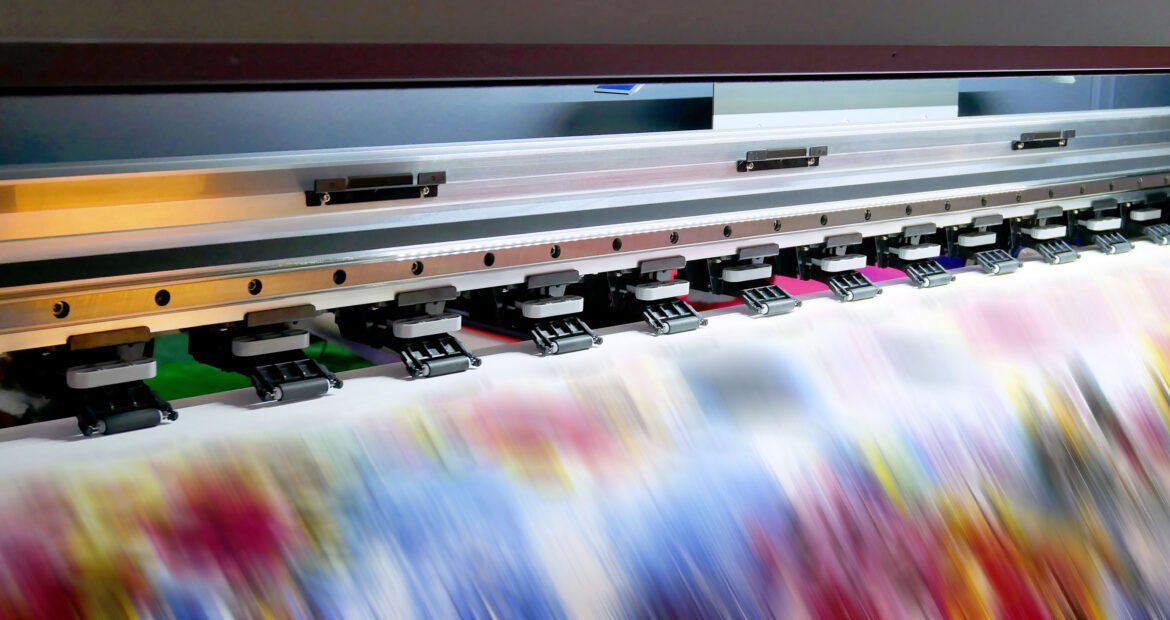
Wide format printing describes specialized digital printing designed to handle media sizes far beyond the limits of standard office or commercial presses. These systems support print widths typically ranging from 18 inches to 100 inches (460 mm to 2,540 mm). Projects larger than 100 inches wide are often categorized as super‑wide or grand format printing.
This technology excels in producing high‑impact, cost‑effective, and highly adaptable large‑scale graphics. It is the preferred method for creating bold signage, exhibition displays, wall murals, and any visual asset where long‑distance visibility and readability are critical.
Unlike traditional sheet‑fed printing, wide format systems usually process media in roll form, supporting continuous output for banners, backdrops, vehicle wraps, and architectural visuals.
The Evolution of Wide Format Printing
Although the broader printing industry has centuries of history, wide format printing is a modern digital innovation that expanded rapidly from the late 20th century onward.
Early wide format systems relied on electrostatic imaging technologies, using static charges to transfer powdered or liquid inks directly onto substrates. Today’s machines use precision inkjet technology, ejecting microscopic ink droplets to deliver sharp, vibrant, high‑resolution imagery across nearly any material.
Modern wide format printers frequently include UV‑LED curing systems. These inks dry instantly under ultraviolet light, contain no harmful solvents, produce zero dangerous emissions, and support eco‑friendly, energy‑efficient production. This technology allows printing on diverse materials without sacrificing image quality or durability – a key driver of global adoption.
Ongoing advancements ensure wide format printing remains an essential tool for scalable visual communication, indoor and outdoor branding, and industrial production.
Market Opportunities and Applications for Wide Format Printing
According to industry market research, the global large format printing market was valued at approximately USD 10.04 billion in 2024 and is projected to reach USD 12.43 billion by 2029, representing a compound annual growth rate (CAGR) of 4.36%.
This expansion is fueled by rising demand from advertising, packaging, textiles, and retail branding. Major brands and businesses increasingly use large format output for out‑of‑home campaigns, event graphics, and environmental branding.
Additional growth drivers include:
- Improved printing speed, resolution, and workflow automation
- Expanded use of eco‑friendly, low‑VOC inks
- Broader substrate compatibility and media versatility
- Customization capabilities for short‑run and personalized projects
- Faster production cycles and reduced operational costs
Wide format printers support a huge range of flexible and rigid materials, making them suitable for countless indoor and outdoor applications:
- Canvas and fine art media
- Self‑adhesive vinyl and wall films
- Large posters, billboards, and PVC banners
- Window graphics and decorative films
- Textile displays and soft signage
Practical uses include trade show booths, retail signage, outdoor advertising, wall murals, architectural visuals, stadium graphics, and theatrical backdrops.
Did You Know?
Several industry leaders specialize in record‑setting large format output. One notable example is a printer named Infinitus, developed over a three‑year period to deliver seamless soft‑media prints up to 600 square meters – roughly 12 meters by 50 meters (40 feet by 150 feet). These systems are widely used for theater backdrops, film and TV sets, large‑scale events, and high‑impact corporate installations.
Conclusion
Wide format printing offers substantial commercial opportunities for print businesses, brands, and creative professionals. However, success requires managing initial equipment investments, ongoing operational costs, and regular maintenance.
The key to long‑term profitability lies in adopting scalable hardware, efficient workflows, and integrated software solutions that manage every stage of production, from file preparation to finished output.
As technology advances and sustainability becomes more important, wide format printing will continue expanding into new sectors, creating fresh opportunities for innovation and revenue growth.